> For the complete documentation index, see [llms.txt](https://documentation.crossengage.io/llms.txt). Markdown versions of documentation pages are available by appending `.md` to page URLs; this page is available as [Markdown](https://documentation.crossengage.io/data-and-engagement-platform/messages/integrations/channels/email/inxmail/create-a-campaign-message.md).
# Create a Campaign Message
* Log in to your CrossEngage account.
* Go to `Campaigns` and click `Create Campaign` in the top right corner of the page.
* Choose whether you want to create an Audience or a Realtime campaign. Information about the distinction between these types of campaigns can be [found here](/data-and-engagement-platform/campaign-management/campaigns.md).
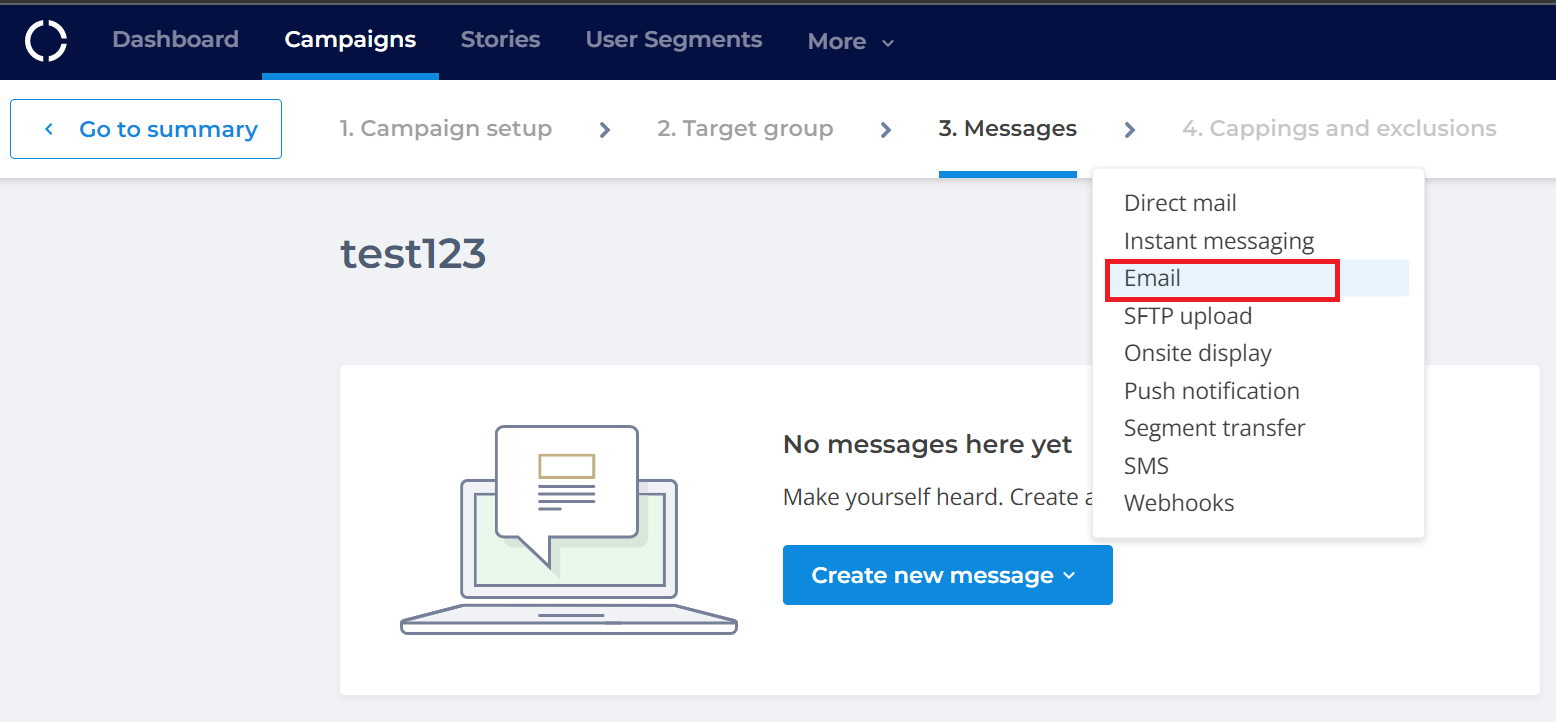
* Once you have created your campaign and filled in the “Campaign setup” and “Target group” sections, go to the `Messages` section and click `Create new message`.
* Select `Email` from the dropdown menu. The message setup screen will open.
Select the Inxmail Commerce integration you set up earlier from the `Send via integration` drop-down.
#### Message setup
Every field (except for the cc and bcc fields) in the message setup may contain handlebars. Learn more about handlebars [here](/data-and-engagement-platform/messages/personalization.md).
**Sender Info**
Fill in the Sender information:
* Sender email address
* Sender name
* You can choose to add reply-to fields. The sender info is considered by default if reply-to fields are not filled.
* You can also add cc addresses by separating the emails with a comma. Emails sent to cc and bcc addresses will not be reflected in the response data.
**Template Source**
* Enter the Subject and HTML template. You can use handlebars to personalize messages.
## **Response Data**
We poll the response data every minute from a REST API endpoint. To receive Open & Click statistics, contact your Inxmail Commerce provider to enable tracking for mail relay.
The following response data is available for this integration:
* Sent
* Delivered
* Open
* Click
* Soft Bounce
* Hard Bounce
* Spam