> For the complete documentation index, see [llms.txt](https://documentation.crossengage.io/llms.txt). Markdown versions of documentation pages are available by appending `.md` to page URLs; this page is available as [Markdown](https://documentation.crossengage.io/data-and-engagement-platform/system-monitoring/events-overview.md).
# Events Overview
CrossEngage allows you to track and view events in the CrossEngage app, such as Events sent by WebHooks or generated by Campaigns. To see a summary of Events in CrossEngage, go to the Debugging Menu and Click on Events Overview.
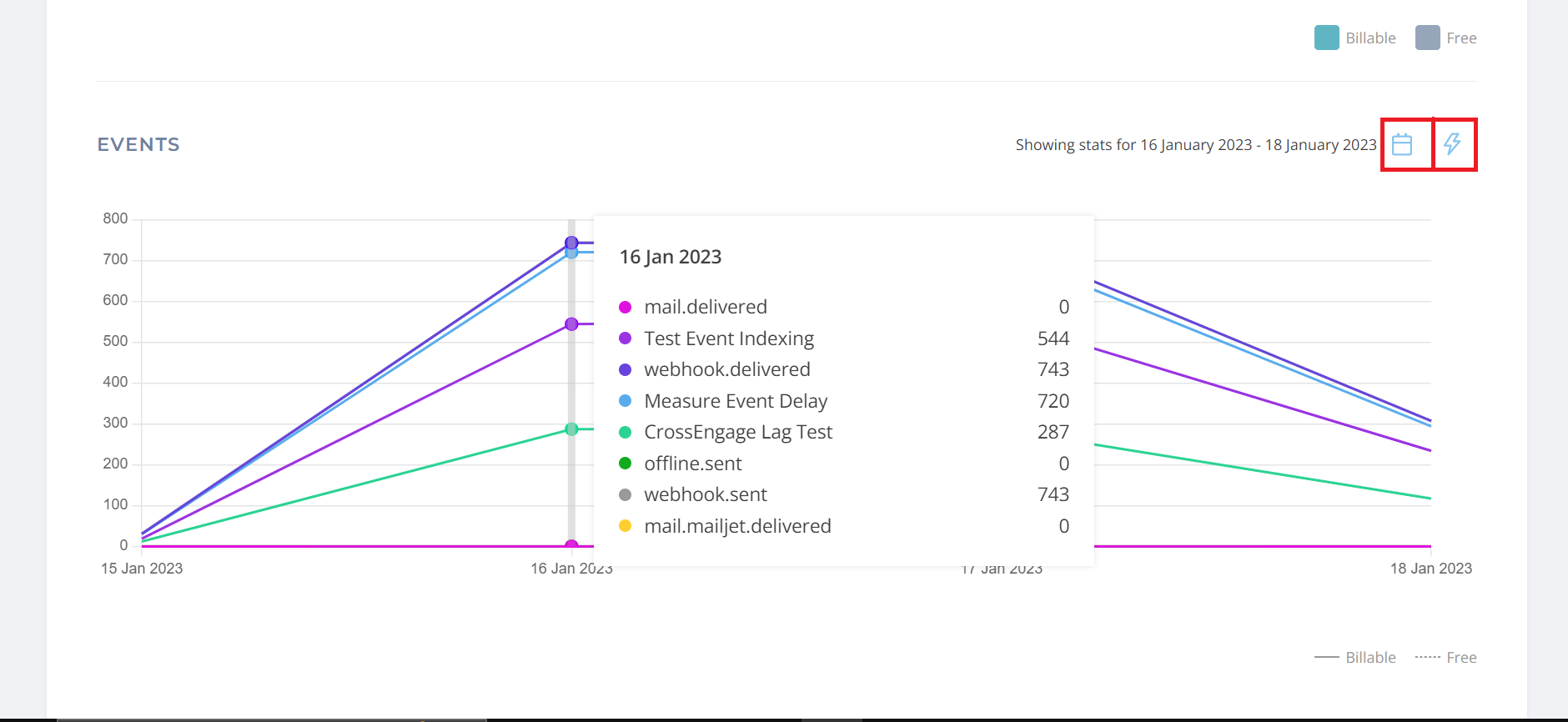
Here, you can see a summary of total monthly events over the last 12 months. Scroll to the second graph on the page.
Click the calender icon on the top right corner of the screen. Here, you can choose the time range for which CrossEngage will show Events. Click the Lightning Bolt icon on the top right corner of the screen. This allows you to specify which Events to display. Using these two icons, you can modify the graph to show your desired Events data.
{% hint style="info" %}
By hovering the mouse pointer over the graph, you can see the number of events for a specific point on the graph.
{% endhint %}
You can also see Events as they are recieved by CrossEngage in Real-Time. Simply go to the Activity Tab, and Click on Event Stream. In the Event Stream page, click on "Start Listening" to see any new incoming Events.
{% hint style="info" %}
You can use the Event Stream to test Webhooks when you integrate them in your website.
{% endhint %}