> For the complete documentation index, see [llms.txt](https://documentation.crossengage.io/llms.txt). Markdown versions of documentation pages are available by appending `.md` to page URLs; this page is available as [Markdown](https://documentation.crossengage.io/data-and-engagement-platform/messages/integrations/channels/email/mailjet/set-up-mailjet-integration.md).
# Set up Mailjet Integration
Before you begin, you will need the following:
* Mailjet Account
* CrossEngage Account
* User data (including an email address)
## **Creating a New API Key**
A Mailjet API key allows CrossEngage to connect to your Mailjet account. To create the API key:
* [*Log in*](https://app.mailjet.com/signin) to your Mailjet account.
* Click on your profile drop-down menu and select `Account Settings`.
* In the “REST API” box, click on `API Key Management`.
* You can choose between two types of API keys: The Primary API Key and the Sub-Account API Key. More information regarding the difference between these two options can be found [here](https://documentation.mailjet.com/hc/en-us/articles/360042561854-What-are-sub-accounts-and-how-does-it-help-me-).
* By default, all Mailjet accounts come with a Primary API Key that grants full access to your account, including but not limited to sending emails, statistics, and information.
* Using the Sub-account API Keys, you can separate your mailings across different API Keys. Find out how to proceed with creating a Sub-account API key [here](https://documentation.mailjet.com/hc/en-us/articles/360042561974-How-to-create-a-sub-account-or-additional-API-Key-).
## Configure Mailjet Integration in CrossEngage
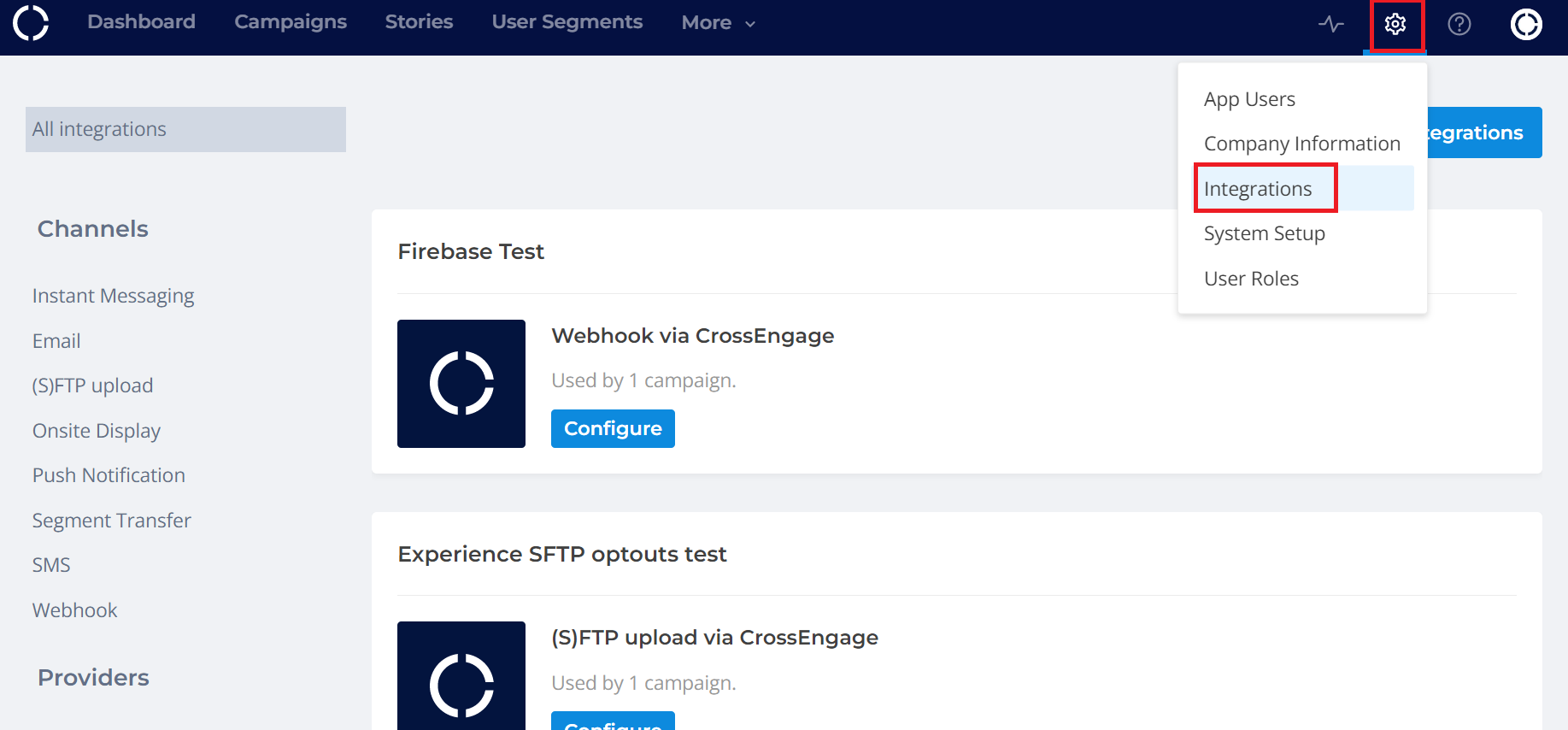
* In the CrossEngage app, navigate to `Settings` > `Integrations`.
* Click the `Add new integration` button in the top right corner of the page.
* Search for Mailjet, then click `Set up`. An integration set-up form will open.
* Enter a clear, descriptive name for your integration in the "Account name" field.
* Insert your Primary API Key and Secret Key into the "API key" and "Secret key" fields respectively.
* Paste the API key that you copied from your Mailjet account during the previous steps into the "Account name" field.
* Click `Connect` and then `Apply` to save your integration.